Meme coin trading on a $10 budget
Need articles like this for your video? They help promote it on YouTube and Google — order them in the Telegram bot @sat_sit_bot. It writes articles around your video, embeds the video and publishes them on popular niche websites (no ads). Try it free: 50 articles on us.
· based on the channel gravy
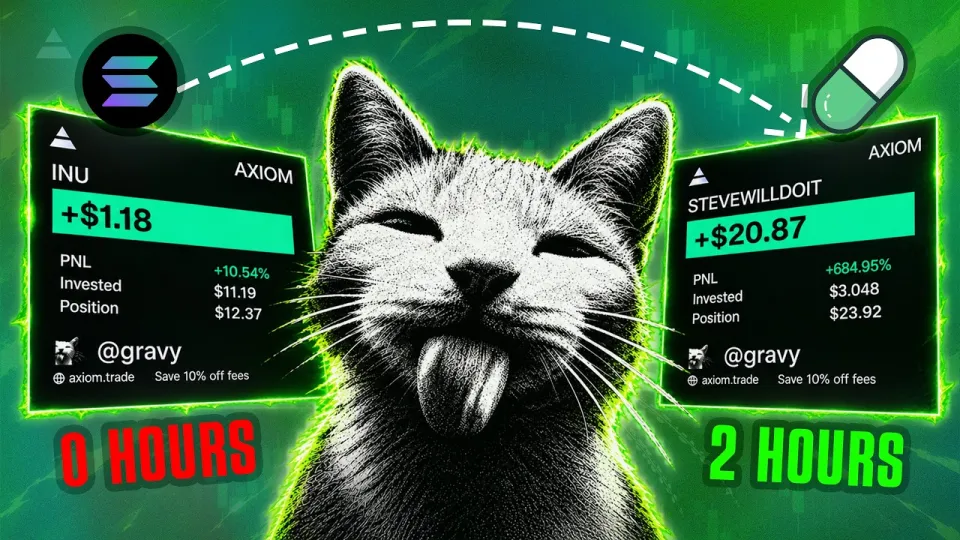
Meme coin trading with a $10 account is possible, but only if every trade is sized so that fees, priority tips and slippage stay a small fraction of the position. In a five-trade experiment, each buy stayed under 0.05 SOL and the results depended less on picking a magic ticker than on narrative timing, fast exits and avoiding one badly handled position. The trades were placed through Axiom's trading terminal, the platform the experiment used for execution.
What a $10 meme coin portfolio can realistically do
A ten-dollar balance is not a strategy, it is a constraint — and the constraint dictates everything else. On Solana, a swap involves a network fee, a liquidity-pool fee and usually a priority tip; on a 0.05 SOL buy, those costs can quietly represent a double-digit percentage before the price moves at all. That is why the common advice — small accounts cannot trade meme coins — exists, and why the test was structured around very small buys rather than one big bet.
The practical rules that follow from the math:
- Keep each position small enough that a total loss does not end the experiment — the video's ceiling was 0.05 SOL per buy.
- Count the round trip, not the entry: fees are paid on the way in and on the way out.
- Avoid overtrading. Ten tiny trades can burn more in costs than one well-timed position earns.
- Treat the balance as tuition. The output of a $10 experiment is a process, not a payout.
The honest framing is that a small portfolio is a simulator with real money attached. It forces discipline about size, timing and exits that a larger account tends to hide.
The five trades: STEVEWILLDOIT, NPC, MET, PUMPY and UNTXD
Each of the five positions had a stated reason to buy and a stated reason to sell, and that pairing is the actual lesson. The tickers were STEVEWILLDOIT, NPC, MET (Meteora), PUMPY the Trader and UNTXD — all small-cap Solana meme plays rather than blue-chip tokens, which means the holding window is measured in minutes to hours, not weeks.
What separates a planned trade from a gamble:
- A thesis before entry. For STEVEWILLDOIT the appeal was a recognisable meme format with an existing audience; for MET it was a token tied to a known Solana protocol name, Meteora.
- A trigger to sell. Taking profit into strength, or cutting when the thesis breaks, beats holding and hoping on a position this small.
- Awareness of the meta. PUMPY the Trader and UNTXD rode short-lived attention cycles around trading culture and launchpad activity.
- Acceptance of variance. With five trades the sample is far too small to call anything an edge.
One of the five was fumbled badly, and that is arguably the most useful data point in the whole set. Small accounts rarely die from a single bad pick; they die from a bad pick that is held too long or averaged down.
Why the X Money coin meta ran
The X Money coin cycle was driven by a narrative stack rather than by fundamentals. The description points to two ingredients: e/acc — the "effective accelerationism" internet movement that treats rapid technological progress as a value in itself — and Cream, a name that circulated inside that same online subculture. When a token attaches itself to a live conversation that influential accounts are already having, attention arrives faster than liquidity, and that mismatch is the entire trade.
For a trader with a tiny balance, the takeaway is not to chase every meta but to recognise the shape of one:
- A narrative already exists in public conversation before the token does.
- A ticker or name maps onto that narrative in one glance.
- Volume and holder count rise together, and the chart is a symptom, not a cause.
- The window closes when the conversation moves on — usually faster than expected.
This is also the hardest part for beginners. Scanning feeds, remembering who has influence in a community and judging whether a narrative is early or already priced in is real work, and it is where most small traders lose rather than in the swap itself.
Fees, slippage and the real cost of tiny positions
Fees are the silent opponent of every low-balance meme coin trader. A position of 0.05 SOL can look profitable on the price chart and still lose money once the round trip is counted, because priority tips and pool fees are roughly fixed while the position is not. Doubling the trade count doubles that drag.
The levers that actually help:
- Fewer, better trades. Each additional round trip pays the fixed costs again.
- Fee rebates and referral perks. Platforms such as Axiom advertise cashback and reduced fees through referral links, which matters proportionally more on small size.
- Slippage control. On thin meme liquidity, a loose slippage setting turns a good entry into a bad one.
- Exit discipline. A fast exit at a modest gain usually beats waiting for a round number that never prints.
The uncomfortable truth is that a $10 account is mostly a fee-paying educational account. It works as training precisely because the costs are visible.
Common questions from small-balance traders
Small-portfolio traders tend to hit the same three walls, and none of them are about picking the right ticker. The first is narrative overload: too many feeds, too many names, no way to tell which conversation is early. The second is exit psychology — selling a 20–40% loss and then watching the same coin run higher, or holding a winner until it round-trips. The third is transparency: viewers of the experiment immediately asked what the final portfolio value was, which is the right question and the one most trading videos dodge.
A workable routine for a tiny account looks like this: pick one or two information sources, write the thesis in one sentence before buying, define the invalidation level in advance, and log every trade with its fees so the real result is visible. Without a log, a $10 experiment produces stories instead of data.
Useful links
- Axiom trading terminal (referral, cashback and fee discount): https://axiom.trade/@gravy
- The Trenches Discord: https://discord.gg/W7TqkExcSd
- Discord with free Axiom imports and trade signals (NFA): https://discord.gg/9W5j3XUgYB
- gravy on X: https://x.com/gravyski
- Leverage trading with reduced futures fees: https://www.bitbase.com/landing-page/trading-earning-Gra?ref=8CYOGY
Bottom line
Trading meme coins with $10 is technically possible and practically a discipline exercise: five sub-0.05 SOL positions, each with a stated reason to enter and exit, produced lessons worth more than the balance itself. The variables that mattered were narrative timing, fee drag and the willingness to cut a fumbled trade instead of defending it. Anyone repeating the experiment should log every trade including costs, because a small account hides nothing. The five-trade breakdown comes from the "gravy" channel, which also asked viewers whether a live session from 0.1 SOL or 1 SOL should come next. If you want to run the same test, start with a registration on Axiom and keep the first buys small.
Key takeaways
- Five real meme coin trades, each buy under 0.05 SOL — roughly the size a $10–$20 account can fund on Solana.
- Tickers covered: STEVEWILLDOIT, NPC, MET (Meteora), PUMPY the Trader and UNTXD.
- The X Money coin meta ran on an e/acc and Cream narrative — narrative timing mattered more than chart patterns.
- Fees and priority tips hit hardest on tiny positions, so trade size and number of trades decide survival.
- One trade was badly fumbled, which is the realistic base rate for low-balance degen trading.
Source: I Tried Trading Memecoins with Just $10 · Markdown version
Questions & answers
Can you actually trade meme coins with only $10?
Yes, but the goal shifts from profit to process. A $10 balance on Solana can fund several buys under 0.05 SOL each, which is enough to practise entries, exits and fee awareness. Expect the costs to eat a meaningful share of any gain, and treat the account as tuition rather than income.
How much do fees and slippage matter on a 0.05 SOL trade?
They matter proportionally more than on a large position, because network fees, priority tips and pool fees are roughly fixed per swap. A trade can look green on the chart and still lose money after the round trip. Fewer trades, tighter slippage settings and fee rebates reduce the drag.
How do you find meme coins with a good narrative?
Watch where public conversation is already happening rather than scanning every ticker. A strong setup is a name that maps onto an existing meta in one glance, with rising volume and holder count confirming attention. The hard part is judging whether you are early or late, which is why a written thesis and a predefined exit help.
Why do small traders sell at a loss and then watch the coin run higher?
Because the exit is driven by discomfort rather than by a plan. Without a predefined invalidation level, a 20–40% drawdown feels like a signal to escape, and the same coin later recovers without you. Deciding the sell conditions before buying, and logging each trade with its fees, removes most of that emotional loop.